
Organic traffic vs. paid traffic: which stream of visitors actually pays off?
Every marketing plan starts with the same question: do you wait for Google to find you, or do you pay for reach? The honest answer is neither one on its own – but the reasoning behind it has shifted noticeably over the past twelve months.
This article compares organic and paid traffic along the points that actually decide your budget: time to results, cost structure, durability and control. On top of that come documented figures on how clicks were distributed in 2026, and a proposal for the split that changes with the stage your project is in.
What is organic traffic?
Organic traffic is every visit you do not pay a click for: unpaid results on Google and Bing, referrals from other websites, mentions in forums and social networks. The currency here is not money, it is time and editorial work.
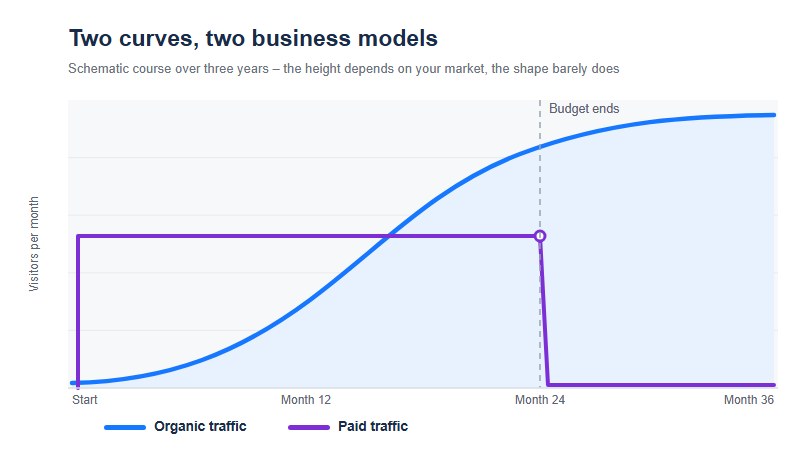
Its big advantage is durability. An article sitting on page one still delivers visitors in its third year without costing you anything more – and every further good article adds to the stock instead of replacing it. No paid channel has this compounding effect.
The price is patience. Experience says it takes three to twelve months before a new page ranks reliably, and in competitive topics rather the upper end of that. During this time you produce content, clear away technical problems and build referrals without any revenue on the other side – this is the dry spell most projects fail at.
On top of that comes a risk you do not control: an update to the search algorithm can move rankings within days. Anyone who hangs their entire revenue on a single search engine does not have marketing, they have a dependency. What to do about it on the page itself is in the glossary under OnPage optimization.
What is paid traffic?
Paid traffic means visitors you pay for directly: search ads on Google, campaigns on social networks, native ads, banner placements and traffic platforms. You are not buying visibility on spec, you are buying clicks or impressions at a price you can calculate.
The advantage is speed. A campaign you launch at lunchtime brings its first visitors the same evening – and with them the first data on whether your landing page works at all. For anything with a date attached, this is the only practical route: a product launch, a season, a limited-time offer.
The second advantage is control. You set the audience, the region, the device and the time of day, you turn the budget up and back down, and you see every change in the statistics within hours. The basics are explained under Pay per Click – a model where you pay only for an actual click.
The drawback sits on the same side of the ledger: the day after your last paid click, the channel is at zero. Nothing is left behind that keeps working – paid traffic is rented, not bought. And in competitive niches, click prices have been rising faster than margins for years.
The direct comparison
The table below puts both channels side by side along the eight points that decide the matter in practice. The ranges are values from experience and shift considerably depending on your industry, your offer and your competition.
| Criterion | Organic traffic | Paid traffic |
|---|---|---|
| Time to results | 3 to 12 months until rankings are stable | Hours to a few days |
| Cost structure | Upfront investment in content, tech and referrals | Running cost per click or impression |
| Cost per visitor once established | Falls towards zero once the ranking holds | Stays flat or rises with the competition |
| Durability | High, the stock builds up | None, the stream ends with the budget |
| Scalability | Limited by search volume and competition | Directly controllable via budget and reach |
| Predictability | Low, dependent on algorithm updates | High, you set the volume and the timing |
| Purchase intent of the visitors | High for searches with a clear intent | Depends entirely on audience and ad |
| Suited to | Building up over years | Launches, tests, seasons and gaps |
Anyone reading this table as a points victory is reading it wrong. The two columns answer different questions: the left one tells you what your business will live on in three years, the right one what happens this month.
Never compare the two channels on conversion rate alone. Paid campaigns almost always come out ahead, because you pick the audience yourself – so the number measures your selection as much as the quality of the channel. The comparison only becomes meaningful once you put cost per completed sale next to it and look at both channels over the same period.
Where things stand
What shifted in the click distribution in 2026
The rule of thumb that organic results get the lion's share of clicks still holds – but it holds less and less, and least of all exactly where the money is made.
An analysis by Aleyda Solis, based on Similarweb data, compared January 2025 with January 2026 across four product categories. The share of classic organic results in all clicks fell in every category: for headphones from 73 to 50 percent, for jeans from 73 to 56, for greeting cards from 88 to 75 and for online games from 95 to 84 percent. The details are at Search Engine Land.
The countermovement happened on the ad side. Text ads gained between seven and thirteen percentage points in all four categories, and if you add shopping ads to that, roughly a third of all clicks on headphones and jeans now land on paid results – a year ago it was half that.
The second trend hits both channels at once. According to an analysis by SparkToro, around 68 percent of all Google searches in the first four months of 2026 ended without any click at all: the answer was already on the results page. So the pie that organic and paid compete over is getting smaller.
What follows for your planning is not "SEO is dead" but something more sober. Organic visibility remains the channel with the best long-term maths, but it carries alone less often than it did two years ago. What content has to look like to show up in AI answers as well is covered under Generative Engine Optimization.
The split
The hybrid model: why the combination wins
The reason to run both is not caution, it is sequence. Paid traffic answers in four weeks the questions organic traffic needs two quarters for – and those answers feed straight into your SEO work.
In practice that means: before you spend six months building content around a topic, you test with a paid campaign whether the landing page carries at all. Which headline pulls, where people drop off, which offer they click – you learn that for a few hundred euros instead of half a year of work.
The other way round, organic traffic makes your paid campaigns cheaper. If you are already visible for a topic, you know the search terms that convert and no longer have to learn them the expensive way. Both channels supply each other with prior knowledge when you run them side by side instead of one after the other.
A proposal for the split by project stage
Launch: the first twelve months
Around 60 to 70 percent of the budget into paid reach, the rest into content and tech. In this phase you mainly need two things organic traffic cannot deliver yet: revenue and data. The content you build alongside only pays off later.
Growth: years one to three
Roughly half and half. The first articles are ranking, the organic share keeps growing on its own, and paid campaigns only run where they pay for themselves: on search terms with clear purchase intent, and on topics you are not yet visible for organically.
Maturity: from year three
70 to 80 percent organic, the rest paid. The stock carries your base revenue, and the paid budget goes specifically into product launches, seasonal peaks and gaps in your rankings. The advantage of this phase is that you can switch paid channels off without revenue collapsing.
These numbers are a starting point, not a law. If your contribution margin is high and your competition weak, everything moves forward; with thin margins in an expensive field, paid traffic can be the wrong choice even in year one.
In practice
Where eBesucher fits into the mix
First, what we are not claiming: booked visitors do not improve your ranking. Traffic is not a ranking factor, and any provider promising you otherwise is selling you an expectation they cannot deliver on. What booked traffic can do sits on a different level.
It fills the gap where your landing page is finished and nobody is looking at it yet. That is exactly when you want to know whether it loads quickly, whether the navigation is understood, at which point people drop off and whether your form works on a phone. Those questions are answered by visitor behaviour, not by a twelfth round of internal feedback.
The economic point behind it is sequence. Organic traffic is the most expensive you have – paid for in months of work. Sending it to an untested page is the most expensive way to find a mistake. Paid traffic beforehand, by contrast, is cheap.
With us you book that reach in two formats: the surfbar shows your page for a display duration you set yourself; with click campaigns the visitor stays for up to ten minutes and additionally leaves you written feedback on your offer. What your bid costs is decided at checkout by an auction, not by a price list.
Do not measure a reach campaign by its purchase rate. Channels at the start of the customer journey deliver attention, not ready-to-buy demand coming out of a search query – and measured against the wrong metric, every one of them looks like a failure. What makes sense here is time on page, scroll depth, intermediate goals such as newsletter sign-ups, and the share of returning visitors. Which numbers are worth your time is covered in the article on marketing KPIs.
A plan for the first 90 days
Day 1 to 30. Finish one landing page and send booked traffic to it. In parallel, work through the technical groundwork: loading time, display on mobile, clean titles and descriptions. Whether your page responds correctly on a technical level takes a minute to check with our URL test; what your search result will look like, with the SERP snippet generator.
Day 31 to 60. Rework the page based on the data – headline, order of sections, position of the button. Only now write the first longer articles, and write them on the topics that actually drew a reaction in the test rather than the ones that sounded good in the workshop.
Day 61 to 90. Shift the budget step by step towards content. Paid campaigns keep running for the pages that pay for themselves and for new tests. From here on the first organic visitors should be measurable – if they are not, the problem is usually not the budget but the target audience or the competition.
Frequently asked questions about organic and paid traffic
Is organic traffic really free?
No. You pay no price per click, but content, technical work and referrals cost time or fees. The difference is in the cost curve: with organic traffic the effort falls at the start and drops afterwards, with paid traffic it falls again for every single visitor.
Can paid traffic hurt my ranking?
Paid campaigns as such influence your ranking neither positively nor negatively – Google deliberately keeps the two apart. Something else can hurt you: a landing page that gets plenty of traffic and fails to hold it, or providers passing off automated requests as visitors. So pay attention to what exactly you are buying, not just to the price.
How long does it take for organic traffic to become significant?
Plan for three to six months before you see results you can rely on, six to twelve in competitive topics. The curve is not linear: for months seemingly little happens, then several pages move at once. Giving up after eight weeks throws the investment away shortly before it starts to work.
Which is better: organic or paid traffic?
The question has no general answer, because the two have different jobs. Organic traffic is the better investment, paid traffic the better response. If you need revenue today, there is no way past paid reach; if you want to be independent in three years, there is no way past content. So the sensible question is not "either/or" but in what ratio.
Is paid traffic still worth it in 2026, with click prices going up?
For launches, seasonal peaks and tests, yes – there is no alternative fast enough. Rising prices do not change the whether, they change the how: you work out in advance what a visitor is allowed to be worth, instead of finding out afterwards that they were too expensive. The target value per visitor is your contribution margin times your expected conversion rate.
Why do so many searches end without a click?
Because Google increasingly answers directly on the results page – through info boxes, snippets pulled from websites and AI summaries. According to the SparkToro analysis, that applied to around two thirds of all searches in 2026. For you it means visibility and visit are no longer the same thing, and both want watching separately.
What does your split look like today – and does it still match the stage your project is actually in? Feel free to write it in the comments.
Good luck with the planning.
Your eBesucher team
Test your landing page with traffic →
Related

0 Comments
Sign in to leave a comment.
Sign in