
A click in Google Search costs an average of €2.32 in Germany. Whether that is expensive, nobody knows but you — because the number that decides it is not with Google. It is in your own calculation.
An example: an €80 basket, a 30 percent margin, a 2 percent conversion rate. Then you can spend 48 cents per click before you start losing money. Depending on the industry, Microsoft Ads sits roughly a third to a half below Google. That is still about €1.40 — three times what you can carry.
This is exactly where most comparison lists run into nothing. They sort channels by what they cost instead of by what you are allowed to pay. This article turns the order around.
Calculate
What a click is allowed to cost you at all. Without that number, every comparison is a coincidence.
Repair
Four settings lower the click price in your existing account — often enough to save the switch.
Switch
Only now, and deliberately: the right channel depends on which of the four problems you have.
Why you are looking for an alternative to Google Ads
"Google Ads alternatives" is almost never the actual question. Behind it sit four very different situations, and they need four different answers. Find yours and read on from there.
| Your situation | How you recognise it | What actually helps |
|---|---|---|
| The clicks are too expensive | The daily budget is gone by lunchtime, the click price is above your ceiling | First calculate, then repair, then channels with the same job |
| Nobody is searching | Hardly any impressions, although the bid and budget would be enough | Create demand instead of harvesting it |
| The account is suspended | Ads disapproved, account deactivated, industry not permitted | The section on suspension — and no second account |
| Clicks arrive, revenue does not | Traffic goes up, completed sales stay the same | None of it. The channel is not the problem here |
Three of these four situations can be solved with a different channel. One cannot — and whoever answers it with a switch anyway pays for the switch and keeps the problem.
What a click is allowed to cost you
One number ten minutes of work decides all the rest
Before you compare any channel, you need a single number: the maximum price a click may have for anything to be left over at the end. For a shop you work it out like this:
The calculation looks trivial until you set it up once with your own figures. What often stands there is an amount far below any click price paid search calls for in that industry. What the conversion rate measures exactly is in the glossary; the table below shows the calculation for a margin of 30 percent:
| Basket | 0.5 % conversion | 1 % | 2 % | 3 % |
|---|---|---|---|---|
| €30 | €0.05 | €0.09 | €0.18 | €0.27 |
| €80 | €0.12 | €0.24 | €0.48 | €0.72 |
| €200 | €0.30 | €0.60 | €1.20 | €1.80 |
| €500 | €0.75 | €1.50 | €3.00 | €4.50 |
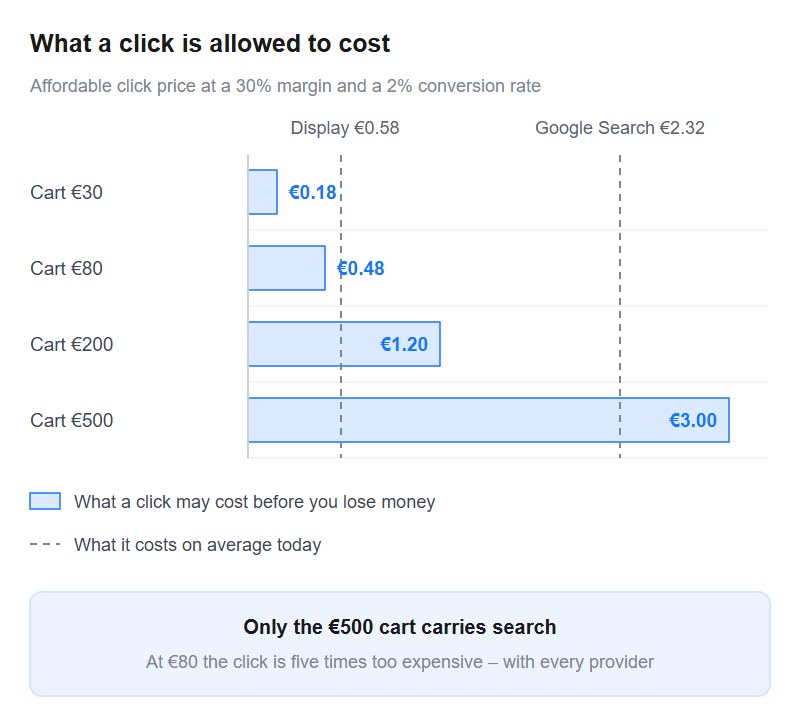
Two cases show how far apart the same platform falls:
The maths does not work
The shop: €80 basket, 2 percent conversion
80 × 0.30 × 0.02 = €0.48. Google Search asks five times that on average. For this shop, paid search is not a price problem but an arithmetic error — and no other search provider corrects it. What is left for an online shop in this position is further down.
The maths works
The trade business: €1,400 contribution margin per job
Every third enquiry becomes a job, 4 out of 100 visitors enquire: 1,400 × 0.33 × 0.04 = around €18 per click. For a local service provider, €2.32 is therefore a bargain, and the whole search for an alternative is moot.
The same ad platform, the same prices, two opposite answers. That is why the calculation comes before the channel comparison and not after it. The actual price in your market is shown to you more precisely by the Keyword Planner in half an hour than by any comparison list.
Before you switch: four settings in your existing account
A high click price is rarely a market price. Most of the time it is the result of settings that have sat unchanged since day one. These four cost nothing but an hour — and they often decide whether a switch is worth it at all.
If the click price is still above your ceiling after that, it is the market price. Then a switch is an answer — before that it was an evasive move. If you want the search terms of your market sorted properly first, our keyword research gives you a finished running order instead of a list of terms.
What a channel switch costs before it brings anything
A switch is never just the difference in click price. Four items come up beforehand, and they are in no comparison table:
From this follows an uncomfortable lower limit: a switch that runs for less than six weeks and gets less budget than the learning phase demands is not a test. It is an expense with an unclear result.
When Google is too expensive: channels with the same job
These channels do the same thing as Google Search — they serve somebody who is actively searching right now. They are therefore the only real replacement channels; everything further down is a different job.
Microsoft Ads. The closest relative, including an import of existing Google campaigns via Microsoft Advertising. Click prices are noticeably lower in many industries, but so is the reach: according to Statcounter, Bing reached 7.12 percent across all devices in Germany in July 2026 and 14.52 percent on desktop, Google 85.59 and 75.37 percent respectively. Do not take it if your audience searches on mobile — there Google sits at 94.41 percent.
Amazon Ads. Search very close to the purchase, because nobody is researching there, they are buying. Do not take it if you are not a retailer or your goods may not be sold on Amazon — the channel is tied to the marketplace, and with it you are building the marketplace's customer relationship, not yours.
Price comparison sites and marketplaces. Idealo, Check24 and the industry portals are search engines with a narrower intent. Click prices are often lower than with Google because there is less competition. Do not take it if you are not the cheapest: in a sorted list it is usually the price that decides, and brand or advice barely matter there.
Your Google Business Profile. Costs nothing, is missing from every list of alternatives, and is the single most effective first step for local providers. A well-kept profile with opening hours, services, photos and answered reviews brings enquiries you would otherwise pay for click by click. Do not take it as a replacement if you sell beyond your region — then it is only one building block.
And search engine optimisation? It serves the same intent and costs no click fee, but it works in months rather than days. As an answer to a budget problem this quarter it is no use — as a second leg alongside, it is. How the two curves behave over a year we put side by side in organic traffic vs. paid traffic.
When nobody is searching: creating demand instead of harvesting it
Paid search has a blind spot: where no search queries exist, it cannot deliver anything. New products, new categories and offers that need explaining fall into this hole regularly. Then no other search engine helps, only a channel that creates attention instead of collecting existing attention.
Meta, TikTok, Pinterest. Audiences instead of search terms — what decides here is how cleanly you have done your audience definition. Contact prices are lower than in search, but so is purchase intent. Do not take it if you want to serve a concrete query like "emergency plumber Dortmund". For that, these channels are the wrong tool.
Newsletter sponsoring and specialist environments. A placement in a newsletter people actually read costs a fixed amount and reaches a group you would never target that cleanly through audience attributes. Do not take it if you want to scale at short notice — slots are limited and often booked weeks ahead.
Reach channels. This is where eBesucher belongs: visits to your own page at a fixed price per thousand contacts, between €0.38 and €0.44, plannable and without an auction. That covers visibility and user signals and helps where statistics are otherwise too thin to say anything. Do not take it if you expect direct sales or enquiries — this route is explicitly not meant for that, and anyone selling it that way is selling you the wrong thing.
If you want to start without spending money at all: with us, advertising credit can also be earned through your own surfing time instead of bought. That is slower, but it costs nothing except time.
When the account is suspended
The most common trigger for the search for an alternative appears in no comparison list: the account is deactivated, or the industry is not permitted in the first place. Three things count then.
Only file an appeal once the point objected to has genuinely been fixed. The notification lists the violated policies individually; an appeal on the off chance only burns a review round.
And plan the interim with several channels. Anyone sourcing all their demand through a single account does not have a marketing problem but a concentration risk — and that holds regardless of whether the suspension was justified.
When clicks arrive but nothing happens
The fourth situation from the table above is the only one where a channel switch definitely does not help. If traffic goes up and completed sales do not, it is not down to the buying but to what happens afterwards. Check four points in this order:
Does the landing page match the ad, or does everyone land on the home page? Is the message visible above the first scroll, or do you have to look for it? How long does the page take to load on an average phone on a mobile network? And how many fields does the form demand before somebody can even get in touch? The technical part of this takes two minutes to check with the URL test; the editorial part you have to decide yourself.
Only once those four points stand does a channel comparison say anything at all. Before that you are only measuring which provider sends visitors fastest to a page they leave again.
The overview
12 channels sorted by job with a rejection criterion
All channels side by side, sorted by job instead of by popularity. The column on the far right is the most important one — it saves you the channels you do not need to test in the first place.
| Channel | Job | Billing | Entry | Do not take it if … |
|---|---|---|---|---|
| Google Ads | harvest demand | per click | no minimum budget | your affordable click price is below it |
| Microsoft Ads | harvest demand | per click | no minimum budget, import possible | your audience searches on mobile |
| Amazon Ads | serve purchase intent | per click | seller account required | you do not sell on the marketplace |
| Price comparison sites | serve purchase intent | per click | product data feed required | you do not win on price |
| Business Profile | get found locally | free | verification required | you sell beyond your region |
| Meta Ads | create demand | per 1,000 contacts | small daily budgets possible | you want to serve concrete queries |
| TikTok Ads | create demand | per 1,000 contacts | over 50 USD per day and campaign | your monthly budget is three figures |
| Pinterest Ads | create demand | per click or contact | small budgets possible | your offer cannot be shown |
| Native networks | create demand | per click | usually three figures a month | you need direct completed sales |
| Newsletter sponsoring | reach a specialist audience | fixed price per placement | lead time in weeks | you have to scale at short notice |
| Reach channels | visibility and user signals | per 1,000 contacts | from small packages | you expect sales or enquiries |
| Search engine optimisation | harvest demand, permanently | working time | effect in months | you need revenue this month |
What is deliberately missing from this table: click prices per channel. They vary so strongly by industry, device and season that a range promises more than it delivers — the comparison lists out there quote values for the same channel that differ by a factor of ten. The number you can rely on is the one from your own calculation. How costs can be compared across channels at all is in our article on the costs of running ads; the terms behind it are explained in the glossary entry on pay-per-click.
Frequently asked questions
Is Google Ads still worth it at all?
That depends on a single number: your affordable click price. If it is above the price in your industry, it is worth it — regardless of what is written about rising costs. If it is below, it is not worth it even if prices fell by thirty percent.
What does a click at Google cost?
In search, around €2.32 on average; in the display network, around €0.58. Both are averages across all industries; in insurance and finance the prices are several times higher, in niches considerably lower.
Where is the best place to advertise?
There is no best environment, only a fitting one. If there are search queries for your offer, you start with search. If there are none, you need a channel that creates attention. The overview above sorts by exactly that.
Is Microsoft Ads really cheaper?
In many industries yes, because fewer advertisers are bidding. In return the reach is smaller, especially on mobile. For a tight budget it is more of an addition than a replacement.
Is there online advertising without click costs?
Yes — any billing per thousand contacts, fixed-price placements and newsletter bookings. There you pay for visibility, not for the click. That is cheaper per contact and riskier per result, because the outcome hangs on your landing page.
What does advertising on Instagram, Facebook or YouTube cost?
These channels bill predominantly per thousand contacts. Comparing that with a click price is misleading — convert both into cost per completed sale, otherwise you are comparing two different things.
What do I do if my Google Ads account has been suspended?
Fix the violation, then file an appeal, and keep running on a second channel in the meantime. Under no circumstances create a new account — that counts as circumvention and makes reinstatement impossible.
Conclusion
The question "which alternative to Google Ads?" is an answer to a problem nobody named beforehand. As soon as you name it, the question falls apart into four cases — and in only one of them is a different channel the solution for click prices that are too high.
So first work out what a visitor is worth to you. That one number decides more about your result than the choice of platform, and it costs you ten minutes. Then clean up the existing account: search terms, landing page, time and place. Whatever is still too expensive after that really is too expensive — only then is it worth looking at the overview.
And if clicks arrive but nothing happens: leave the channel question alone. It is then the most expensive distraction from the actual building site.
Next steps
You have worked out your affordable click price, cleaned up the account, and search is still too expensive? Then billing per thousand contacts is the next step, not the next provider. The price overview shows what reach costs in fixed packages — and what it is good for and what it is not.


0 Comments
Sign in to leave a comment.
Sign in