
What does it cost to run ads?
Ask what running ads costs and you rarely get a number in return. Mostly you get a proposal, a meeting and a monthly report – and at the end you know what you paid, but not what exactly for.
Yet the question can be answered. You only have to bring the costs onto a common unit: a thousand contacts. Then it becomes visible that what lies between the channels is not a few percent but a factor of ten.
This article works through it. It shows the prices of the big advertising channels with their source, the metrics you compare them with, and the items that appear on no invoice. And it shows what changes when you steer your campaign yourself instead of having it steered for you.
The comparison
Running ads: costs across the channels
Cost per thousand contacts (CPM) is the only number that lets channels be laid side by side. It says what a thousand contacts cost – regardless of whether you are billed per click or per impression. The values below are not estimates but published figures from the respective source.
| Channel | Cost per 1,000 contacts | Source |
|---|---|---|
| eBesucher | €0.38 – €0.44 per 1,000 visits | price calculator on ebesucher.com |
| €4.71 per 1,000 impressions | HubSpot | |
| from €5.00 per 1,000 impressions | adconsulting.de | |
| Google search ads | €2.32 per click | Löwenstark |
| Google Display | €0.58 per click | Löwenstark |
Figures according to HubSpot, adconsulting.de and Löwenstark, retrieved in September 2026; they describe the German market. The eBesucher figures come from the worked example on the prices page.
And now the part a serious comparison has to add: an impression is not a visit. On Facebook and Instagram you pay for your ad appearing in the feed – whether anybody notices it is an open question. At eBesucher you pay for your page being opened in a person's browser.
So the comparison errs on the cautious side. Even counting generously and equating one impression with one visit, the difference is tenfold. Counted honestly, it is bigger.
What €110 buys in three channels
€110.00 is the smallest amount in the eBesucher worked example. It lets the difference be shown without any percentages – you only have to divide the number by the respective price:
| €110 budget | Result |
|---|---|
| eBesucher | 250,000 visits |
| Facebook, at a CPM of €4.71 | around 23,000 impressions |
| Facebook, at a click price of €0.35 | around 314 clicks |
| Google search ads, at €2.32 per click | around 47 clicks |
250,000 against 47. That is not a trick of arithmetic but the difference between a channel built for reach and one aimed at purchase intent. Somebody clicking a Google search ad has just searched for something – and for that, the €2.32 is often money well spent.
For everything else – awareness, reach, a product launch, the metrics of your website – you pay Google and Meta a premium for an intent you do not need at all. That is exactly where the cheaper channel pays off.
The metrics
The three values you compare advertising costs with
To compare offers you need three metrics. They are in every ad account, they are called the same everywhere, and each of them can be checked with a pocket calculator – every one in a single step.
CPM – what a thousand contacts cost
Total cost divided by contacts, times 1,000. Spend €50 and get 10,000 impressions and you are paying a CPM of €5. That is the number for comparing channels, because it is independent of how large your budget was.
CPC – what a click costs
Total cost divided by clicks. The CPC tells you what the way onto your page costs. Careful when comparing: a low CPM with a high click-through rate beats a low CPC with a poor ad – the two values always want reading together.
CPA – what a completed sale costs
Total cost divided by completed actions, meaning purchases, enquiries or sign-ups. The CPA is the only metric that decides profit or loss in the end. Everything before it is a preliminary stage.
The order matters: the CPM is for buying, the CPC for optimising, the CPA for deciding. Look at only one of the three and you either buy too expensively or stop too early.
The hidden items
How expensive running ads gets when others do it for you
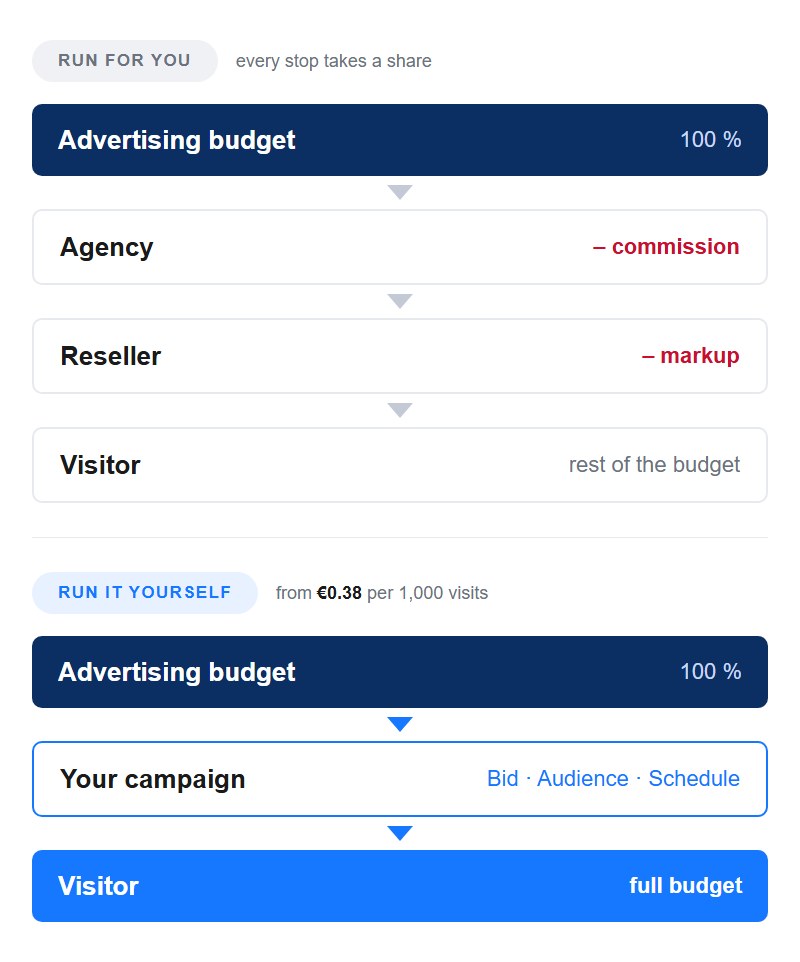
The price per contact is only the visible part. As soon as an agency, a reseller or a network stands between your budget and the visitor, three items are added that appear in no price list – and together they often cost more than the media placement itself.
1. The working hours
According to Commerzbank, a copywriter or graphic designer costs €60 to €80 an hour, a writer for web content €30 to €50, and an advertising photo shoot €500 to over €1,000. These items arrive before a single visitor has seen your page.
With the surfbar they do not arise, because you need no ad creative at all: your page itself is the ad. Anyone who does not have to have a banner designed and an ad text written saves the entire production block. For click campaigns we create the ad graphic for you: a screenshot of your website. Optionally you upload your own graphic (350 x 350 pixels).
2. The minimum budgets
Many ad sellers only take campaigns from a certain size upwards. At one German media seller, the YouTube package starts at a minimum budget of €2,500, a click campaign with a sitebar at €5,000 and an Amazon combination package at €6,000. Anyone wanting to test smaller does not get in.
At eBesucher that threshold does not exist. You buy advertising credit in the amount that suits you and can find out with a two-figure sum whether your landing page carries at all – before you commit to a budget that hurts.
3. The delay
The most expensive item appears on no invoice. When a bid needs adjusting, a region excluding or a campaign stopping, it turns into an email, a ticket, a call back. A two-minute decision becomes two days – and in the meantime you keep paying.
On top of that comes the view of the data. Anyone not operating the campaign themselves usually sees a prepared monthly report instead of the running numbers. With that you can explain in hindsight what happened, but you can no longer intervene while it is happening.
The controls
Running ads yourself: four controls in your account
Running them yourself does not mean working everything out alone. It means that the four controls which decide cost and outcome sit in your account and take effect immediately.
Your bid
In eBesucher bidding you set yourself how much advertising credit a single visit may cost. Go up and your campaign is delivered more often; go down and the cost per visit falls. Nobody sets this value for you, and nobody earns on the difference.
Your audience
The visitor filters know more than a dozen criteria. You choose country and language, restrict to German-speaking countries or open the campaign worldwide. The reload cap additionally sets how often the same visitor may see your page again at all.
Your schedule
Delivery can be steered by hour, day and week. A shop puts its visits into the evening hours, a product launch pulls the first three days forward. Pausing and resuming is possible at any time – there is no contractual commitment.
Your numbers
Every campaign keeps its own statistics with visit counts, cost per visit and further metrics over a period you choose freely. Several campaigns may run in parallel, so you can compare two landing pages or two bids directly side by side.
The effort involved is smaller than it sounds. The bid is one field, the audience a selection, the schedule a grid. What you invest is a few minutes when setting up and an occasional look at the statistics – in return you get a campaign you can stop at any time.
Start with a low bid and raise it in small steps until delivery reaches your daily target. That way you find the price at which your campaign runs – instead of paying the price somebody else accepted on your behalf.
Prices
Advertising online: prices at eBesucher
The worked example on the prices page starts from the default settings of the order form: surfbar, a bid of 2 BTP and a 30-second display duration. It also shows that the price per visit falls when you buy bigger – a volume discount you get without negotiating:
| Visits | Price | per 1,000 visits |
|---|---|---|
| 250,000 | €110.00 | €0.44 |
| 625,000 | €260.00 | €0.42 |
| 1,250,000 | €475.00 | €0.38 |
More important than the individual number is that you know it beforehand. The credit is bought, the bid is set, and a campaign cannot spend more than your credit. There is no additional payment at the end of the month.
On top of that, visits are checked by the independent service AdScore. A campaign is only cheap once advertising-relevant visits actually appear in your statistics – the check makes sure the low price does not come at the expense of quality.
Advertising your own website: two routes
For reach at low cost, the surfbar fits: your page is displayed in the visitor's browser for the time you set, and you need no ad creative of your own for it. That suits awareness, building reach and working on metrics such as time on page and bounce rate.
Through the visitor session you show the same visitor several subpages one after another. For analytics metrics, that is the difference between a single view and a path – and therefore a lever on the bounce rate.
If you are after deliberate interaction, click campaigns are the second route. The visitor sees your ad and actively clicks on it, and you set the dwell time up to ten minutes. There is also the jackpot: on the landing page, jackpot graphics appear for a few seconds for users of the eBesucher add-on, bringing extra points. Anyone who wants to collect them has to look through your page – which gives your content an attention a mere page view does not deliver. How often a jackpot appears depends on your bid: a few BTP above average and it is shown more frequently. It is financed out of the bid – you never pay more than your maximum bid for it.
Honestly
When you are better off having ads run for you
A campaign is never finished on launch day. The first bid is an estimate, the first audience an assumption, the first landing page a guess. What turns that into a good campaign are the changes in the weeks afterwards – and only someone with the controls in their own hands makes them.
Steering it yourself means, in practical terms: you see that the evening hours run better and move the schedule the same day. You notice that your home page needs more than half a minute and raise the display duration. You turn the bid up in small steps until delivery hits your daily target – and back down as soon as it goes over. Each of these changes is one field in a form and takes effect immediately. Together they are the difference between a campaign that runs and one that gets better.
Hand the campaign over and exactly this part often falls away. Not out of ill will: the budget is paid, the campaign runs, the numbers look tidy in the monthly report – and the settings from day one are still there in the third month. For you this campaign is the project; for the intermediary it is one of many. Whoever adjusts does so out of care; whoever does not will not notice it in their fee.
That does not make an agency the more expensive route in principle. Anyone running ten campaigns across several channels, buying in creative work and reporting weekly is in good hands there – what is paid for then is exactly that work, not the passing on of a budget. And anyone needing enquiries for a product that requires explanation will struggle to get past search ads, because that is where purchase intent sits. A channel built for reach does not replace that – it complements it, at a fraction of the cost.
So the question is less who sets the campaign up than who still touches it in week three. If you want to steer it yourself but not start from zero: the eBesucher support team advises free of charge, permanently, by email and phone. The campaign stays in your account and under your control.
Frequently asked
Frequently asked questions about the costs
What does running ads at eBesucher cost?
250,000 visits cost €110.00, which is €0.44 per 1,000 visits. At 1,250,000 visits for €475.00 the value falls to €0.38. The price per visit you determine yourself through your bid.
How much budget do I need at the start?
There is no minimum budget. It makes sense to start with an amount that lets you test your campaign properly, and to raise the bid until the campaign is being delivered. After that you know what your price level is.
Run ads yourself or have them run for you?
Running them yourself pays off as soon as the channel is simple enough that setting up takes minutes instead of days. As soon as creative work, several channels and reporting come into it, an agency is worth its money. The question is not pride but effort against benefit.
How quickly do I see first results?
A campaign you set up today delivers visits the same day, and with them the first numbers. That is the difference from organic visibility, which takes months.
Can I stop the campaign at any time?
Yes. Pausing, changing and resuming is possible at any time in your account, there is no contractual commitment and no notice period. At most, what gets spent is the credit you bought beforehand.
Good luck with your next campaign!
Your eBesucher team
Related


0 Comments
Sign in to leave a comment.
Sign in