
You have worked on your site for two years, and it sits at position 38. Your texts are longer and more precise than those of the competitor in third place, the loading time is fine, the structure too. At some point you come across the explanation that is everywhere: you are missing links. And because the budget is small, the search goes like this: build backlinks for free.
The first page of results offers you 200 web directories, a guide to forum signatures and a deal for "500 links for 49 euros". All of it sounds like a shortcut, and all of it is quickly done.
Three months later you have 60 entries, unchanged rankings and the dull suspicion that you have just broken something. That is the normal case. Not because free link building no longer works, but because most guides out there describe routes that worked ten years ago and have been devalued by Google ever since.
Are backlinks still important? Why building backlinks for free feels so slow
Yes, they are – and that is exactly the problem. To Google, a link is a recommendation. That is the whole idea behind it, and it also explains why the easy routes no longer carry: a recommendation anyone gets without giving anything in return is not a recommendation.
That is precisely what happened to the open submission forms. Every directory that accepts without review has filled up over the years with entries nobody checked. For a search algorithm, such a source is no longer a signal but noise. Your tidy entry sits there among a thousand others and shares their fate.
So the effort behind links has not disappeared. It has only moved: away from filling in forms, towards the question of why anyone would link to you voluntarily. That question costs more time than 60 forms – and it is the only part of the work that does not wear out.
How Google devalues bad backlinks: from Penguin to SpamBrain
Penguin: since April 2012 In the core algorithm: since September 2016 Link Spam Update: December 2022
The break came in April 2012 with the Penguin update. Since September 2016, Penguin has run as part of the core algorithm, so continuously instead of in waves. The decisive change is one that often goes unnoticed: since then, Penguin usually no longer penalises the site but devalues the individual link.
With the Link Spam Update in December 2022, Google extended this approach to its machine-learning spam system. Unnatural links are detected and neutralised. At the time, Google explicitly wrote that sites relying on such links could lose rankings.
For you that means something uncomfortable: the cheap link usually does not cost you a penalty. It simply does nothing. And because nothing happens, the mistake does not show – you carry on, submit to the next directory and wonder about it six months later.
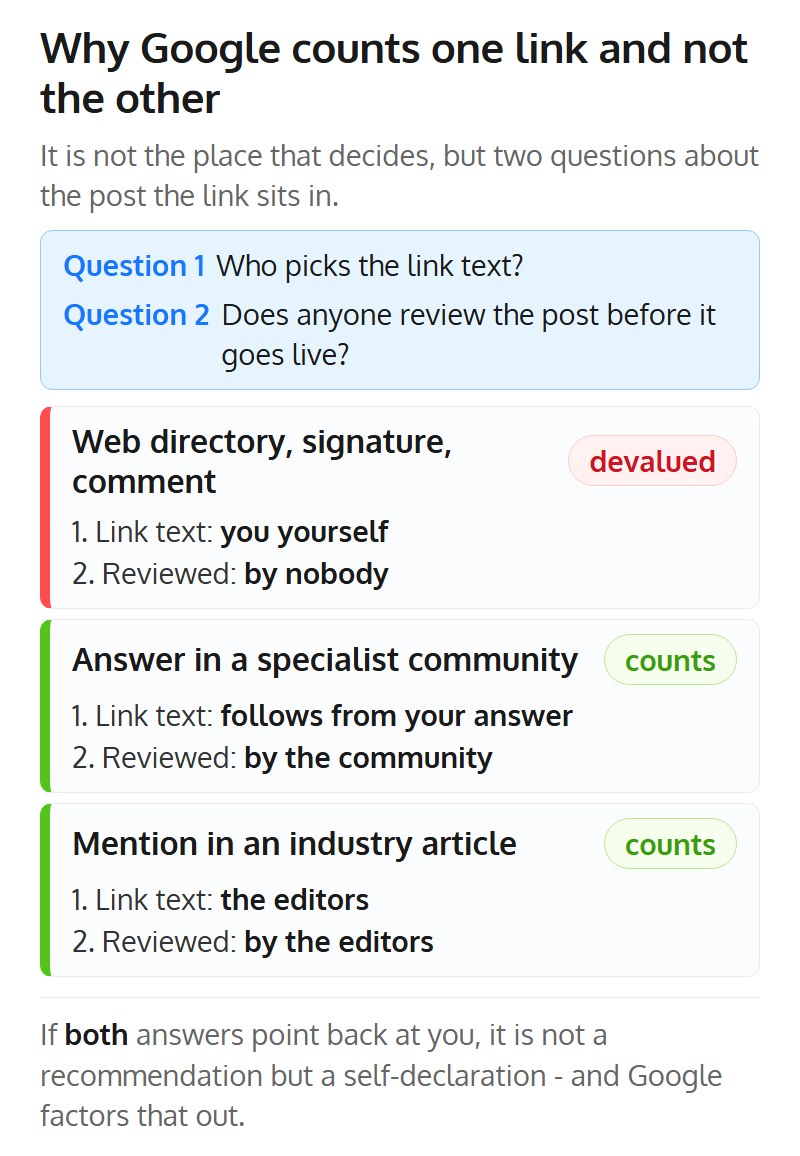
Spotting bad backlinks: five patterns that are burnt
Google's spam policies name link spam with examples. Once you have read the list, you recognise most of the guides out there immediately:
These five routes share one characteristic, and it lets you spot every new trend that turns up tomorrow: you decide the anchor text, and nobody reviews the post. Where both come together, there is no recommendation, only a self-declaration. An algorithm that has been trained on exactly this pattern for over a decade reads it that way too.
Submitting backlinks instead of earning them: what the shortcut really costs
The bill is rarely drawn up, because no money changes hands. Yet you pay in the more expensive currency. Sixty directory entries are a full weekend, and the measurable return is zero.
On top of that comes the clean-up. Anyone who inherits a conspicuous link profile years later sits over disavow lists and emails nobody answers. Those hours arrive long after the supposed shortcut is forgotten.
The heaviest cost, though, is what you did not do in the same time. The same two days spent on an analysis that exists nowhere else leave behind a text somebody can link to – and that will still be linked in five years. Spam entries do not even leave you an insight about your audience.
And while the weekend evaporates, the competitor in third place is building exactly that kind of content. The gap is not growing because the others are faster. It is growing because they are slow in the right place.
Removing bad backlinks – and when you are better off leaving them
The obvious reaction to the last two chapters is to clean up: find old entries, write to the operators, devalue the rest through a disavow file. In most cases that is wasted time.
The reason is already above. Since Penguin, Google devalues conspicuous links rather than penalising the site for them. What gets discounted anyway does not need reporting a second time. As long as there is no manual action for unnatural links in Search Console, doing nothing is the right answer. The disavow file is a tool for the exception, not for everyday use: filling it as a precaution is more likely to cut away usable references than to repair anything.
Three cases justify the effort anyway:
For taking stock, the links report in Search Console is enough; it is free and shows you the referring domains. You can usually save yourself the trouble of writing to the operators: anyone running an unreviewed directory does not attend to removal requests. The route then leads straight to the disavow file, and at domain level rather than link by link.
Building good backlinks: five routes that carry without a budget
All five share the same precondition: there has to be a reason why someone links to you. The first is the most uncomfortable and the best.
Checking and building backlinks: a 90-day plan
Start with a measurement, not with an enquiry. Twenty personal emails take longer than two hundred forms, and three replies out of them bring more than all the forms put together.
Two rules go along with this. First, the pace: a profile that grows slowly over years looks different from one that jumps by three hundred entries in a fortnight. Second, the anchor text. The majority of your links should carry your brand name or the bare address. The exactly matching search term as anchor text is the exception, not the rule – how backlinks are assessed in detail is in the marketing glossary.
And then comes the part no guide shortens: waiting. Weeks to months pass before Google has found, classified and assessed the new posts.
After the ninety days, therefore, you do not check the ranking but the intermediate steps. How many more referring domains does Search Console show now than at the start? How many of your twenty enquiries were answered at all? And is the content with your own numbers now showing up in the result lists itself? If none of these three numbers moves, it is rarely Google's doing and almost always because the content gives nobody a reason to link.
What backlinks cost when there is no time for the free route
7 links €69.00 fixed price eBesucher since 2002
Ninety days of consistent work are out of reach for many projects. Anyone running a site on the side realistically does not have those twenty enquiries in the calendar. At this point it is more honest to lay out the paid route openly than to claim a free solution that does not exist.
eBesucher has been on the market since 2002 and offers question-and-answer backlinks for this: seven links from communities in a question-and-answer format, at a fixed price of €69.00. The format is the point that matters – the link sits inside an answer to a question that was asked, so inside a text that explains what it is about. That is the opposite of the pattern from the third chapter, where the anchor text is freely chosen and the context is arbitrary. At the end you receive the list of all seven links and can see for yourself where your reference stands.
What these seven links do not do: they will not turn position 38 into position 3. They do not work instantly but over weeks. And they do not replace content that carries – links move you forward when the page behind them holds up.
That leaves the waiting time. While Google is classifying the posts, nothing happens to your visibility, and this is exactly the phase in which many give up. If you need visits to your page during that period – for visibility and for more stable numbers in your analytics – you can cover that by buying visitors. This route is explicitly not meant for sales or enquiries; it covers user signals and reach, not the sale.
Conclusion
Building backlinks for free is possible, but it is no longer a matter of diligence. The routes that can be handled by repetition – directories, signatures, link exchanges – have been devalued since Penguin and have been neutralised by machine since the Link Spam Update in 2022. They do not cost you a ranking, they cost you time.
What remains are five routes that all share the same precondition: there has to be a reason why someone links to you. Your own numbers supply that reason most reliably, your own surroundings most quickly. Measure your stock, build one piece of content worth citing, and write twenty good enquiries instead of two hundred bad submissions.
If you do not have the time for that, buy the start – but with realistic expectations and in a format that looks like a recommendation because it is one.
Next steps
If you want to build backlinks for free but cannot spare the ninety days for research and enquiries, you can shorten the start: seven links in question-and-answer posts at a fixed price, with the complete link list at the end for checking. And because links take weeks to take effect, the time until then can be bridged with visits – for visibility and solid user signals, not for the direct sale.


0 Comments
Sign in to leave a comment.
Sign in